
For Survivors
It can be hard to talk about sexual violence. Some people never tell anyone about what happened and are afraid of being blamed or not being believed.
When someone has been sexually abused, violated, or harassed, it is normal for them to notice changes in their feelings, their body and their actions. These changes may occur immediately or months or years later. Everyone responds differently. There is no right way to react, and healing takes time.
Family and friends may want to help but may not know what to do or say. SARA’s staff and volunteers will listen in a caring and understanding way. We offer information and support to help survivors make decisions to support their healing.
If you'd like to talk to someone about what resources are available, SARA advocates can provide guidance on options for support and care, connections to local resources, and accompaniment to medical and legal services.
Street Sheet
Resources list for Charlottesville/Albemarle. Includes public meals, homeless services, literacy/GED, veteran support, employment, clothing, discrimination services, emergency food, mental health & substance use support, sexual assault advocacy, transportation, social services, women's & family health, physical health, and more!
Survivor-Specific Resources
Adult Survivors of Child Sexual Abuse
If you’re an adult who endured sexual abuse as a child, we want you to know this truth: It was never your fault, and it’s never too late to seek support.
Many survivors of child sexual abuse wait years or even decades to tell anyone what happened to them. There are several reasons children and teens may not choose to disclose. Some of them may resonate with you:
-
Communication barriers. Very young children may lack the language or cognitive ability to understand and describe their experiences. The same can be true for young people with cognitive or developmental disabilities.
-
Lack of clarity. For some kids, survival mechanisms kick in, allowing them to dissociate during the abuse or suppress memories of it.
-
Lack of support. Depending on a survivor’s developmental stage or home environment, they may feel afraid that no one will believe them or that they’ll get in trouble if they tell—and they may not be wrong.
-
Fear of retribution. Some perpetrators silence the children they abuse by threatening to hurt them or loved ones.
-
Self-blame. Some survivors feel embarrassed or ashamed, blaming themselves for the abuse. Perpetrators can be quick to use guilt tactics to shift blame. (RAINN.org)
Harm Even After the Abuse Ends
Child sexual abuse profoundly affects survivors, often manifesting years or even decades later.
The coping mechanisms developed by the brain during childhood often persist into adulthood. Adult survivors of abuse may experience any number of these impacts:
Guilt, Shame, or Self-Blame
Society’s stigmas and misconceptions around sexual abuse can prompt survivors to feel guilty or blame themselves. The truth is that you are not in any way responsible for what someone else did to you.
Intimacy & Relationship Challenges
Early sexual abuse can significantly disrupt a survivor’s understanding and experience of intimacy. If you have difficulty trusting partners, experience anxiety during intimacy, have intrusive memories or flashbacks, or behave in ways even you don’t understand, you aren’t “crazy” or “broken.” Healing isn’t fast, but it is possible, and it can help you become the kind of partner you want to be.
Self-Esteem & Self-Worth Struggles
Negative and harmful messages from abusers or the experience of betrayal can profoundly impact a survivor’s self-image, leading to long-term difficulties in personal, professional, and social spaces. Maybe you struggle to believe good things about yourself, need constant reassurance to feel okay, or don’t see yourself as intrinsically worthy of love and fulfillment. If so, you may be suffering the very real aftereffects of childhood trauma. (RAINN.org)
The Sexual Assault Resource Agency is here to support.
-
Listening and validating your experience.
-
Creating plans for safety and coping.
-
Connecting you with resources that meet your needs.
-
Advocating for you as you interact with service providers.
-
Connect with us through our 24/7 hotline: 434-977-7273


LGBTQIA2S+ Survivors
SARA provides free, confidential support services to all survivors inclusive of race, gender, sexual orientation, gender expression or identity, age, economic status, education, parenthood, physical and/or mental abilities, national origin, immigration/documentation status or any other status.
Your fears are valid and reasonable.
-
Fear of asking for help if it means coming out.
-
Fear of seeking medical treatment from a provider that may not understand your gender or sexuality.
-
Fear of isolation from your community to avoid the person who cased harm.
The Sexual Assault Resource Agency is here to support.
-
Sharing affirming local and national resources.
-
Connecting with providers that respect your identity.
-
Creating plans for safety and coping.
-
Advocating for you and interrupting homophobia and transphobia as you interact with service providers.
You have options.
Medical Care
Physical Injuries and Strangulation Assessment
-
UVA Emergency Department*
-
Primary Care Provider
Sexual & Reproductive Health
-
UVA Emergency Department*
-
Primary Care Provider
-
Blue Ridge Health Department
Evidence Collection (within 120 hours)
-
UVA Emergency Department (no cost)*
*A confidential advocate from SARA will automatically be dispatched by the UVA hospital to provide support.
Reporting
-
A report to law enforcement is not required to collect evidence or access support services.
-
SARA advocates can accompany you while making a report to law enforcement.
Local Resources
National Resources


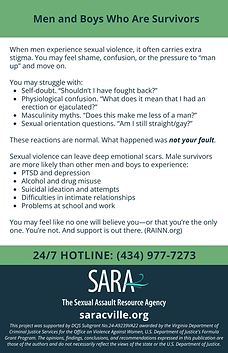
Men and Boys who are Survivors
When men experience sexual violence, it often carries extra stigma. You may feel shame, confusion, or the pressure to “man up” and move on.
You may struggle with:
-
Self-doubt. “Shouldn’t I have fought back?”
-
Physiological confusion. “What does it mean that I had an erection or ejaculated?”
-
Masculinity myths. “Does this make me less of a man?”
-
Sexual orientation questions. “Am I still straight/gay?”
These reactions are normal. What happened was not your fault.
Sexual violence can leave deep emotional scars. Male survivors are more likely than other men and boys to experience:
-
PTSD and depression
-
Alcohol and drug misuse
-
Suicidal ideation and attempts
-
Difficulties in intimate relationships
-
Problems at school and work
You may feel like no one will believe you—or that you’re the only one. You’re not. And support is out there. (RAINN.org)
You have options.
Medical Care
Physical Injuries and Strangulation Assessment
-
UVA Emergency Department*
-
Primary Care Provider
Sexual & Reproductive Health
-
UVA Emergency Department*
-
Primary Care Provider
-
Blue Ridge Health Department
Evidence Collection (within 120 hours)
-
UVA Emergency Department (no cost)*
*A confidential advocate from SARA will automatically be dispatched by the UVA hospital to provide support.
Reporting
-
A report to law enforcement is not required to collect evidence or access support services.
-
SARA advocates can accompany you while making a report to law enforcement.
Local & National Resources

Survivors who are Incarcerated
All survivors of sexual violence deserve support and healing. Many of our community members within the correctional system are impacted by the trauma, resulting from sexual violence. In response, SARA provides vital support to these survivors.
The Prison Rape Elimination Act (PREA) is a federal law that establishes legal requirements for the prevention, detection, and response to sexual abuse and sexual harassment of people who are incarcerated.
If you'd like support navigating resources for survivors who are incarcerated, please connect with a SARA advocate.
SARA partners with 3 agencies: Albemarle-Charlottesville Regional Jail, Fluvanna Correctional Center for Women, and Blue Ridge Juvenile Detention.
Key Concerns
-
Isolation and limited privacy
-
Proximity to the person who caused harm
-
Restricted access to resources or support services
-
Loss of control over personal safety and environment
Considerations
-
Recognize the unique barriers to disclosure and understand that reporting can be risky
-
Build trust through confidentiality, consistency, and nonjudgmental support
Reporting
Every facility is required to employ a PREA Coordinator, who investigates reports of sexual violence. Reports can be made directly to the coordinator or any facility staff.
Safety Planning
Identify trusted peers and/or correctional officers (COs) and discuss emergency options (alert buttons or safe areas).
Mental Health & Well-Being
Explore participation in counseling or other groups and educational classes offered at their facility.
Resource Connections
-
Within 120 hours of sexual violence, individuals can request a PERK (Physical Evidence Recovery Kit).
-
SARA or their local sexual violence agency may be able to provide direct support within the jail.
-
Other local resources include:
After Release
Refer individuals to SARA or their local sexual violence agency to reconnect with advocacy and counseling services such as:
-
Assistance with basic needs and stabilization, including housing, food security, transportation, and education or job training programs.
-
Guidance navigating legal systems, including law enforcement interviews and court proceedings related to sexual violence experienced.
-
Help connecting with long-term counseling and community reintegration resources.

